Design controls as software products.
Manual controls are tickets, documents, and trust. An engineered control is code: versioned, tested, owned, and observable.
GOVERNANCE ENGINEERING
The application of software engineering principles and tools to automate SDLC governance.
Engineer governance as code in your pipelines, not tacked on as a retrospective pen and paper process
Ensure the safety and auditability of every control through cryptographic proof instead of human checks
Go from retrospective and sampled control testing to continuous reconciliation - no gaps, no findings.
You automated build, test, and deploy years ago, but governance still runs on forms, meetings, and screenshots. Everyone pays - engineers in toil and delays, security in poor risk control, audit in cost and findings.
Automated
Code
minutes
Test
minutes
Deploy
minutes
Still manual
Governance
days to weeks
Evidence
Legacy Governance
Screenshots, tickets, and exports, assembled by hand.
Governance Engineering
Captured automatically at the point of action.
Controls
Legacy Governance
Policy documents, enforced by meetings. Over 90% of changes rubber stamped.
Governance Engineering
Automatic policy enforcement and evidence.
Audit
Legacy Governance
Expensive, retrospective, time consuming and sampled.
Governance Engineering
Continuous assurance over every event
The FCA analyzed over 1M production changes and found manual governance correlates with worse outcomes. DORA research shows formal CAB approval makes low performance 2.6x more likely. And regulation (EU DORA, NIS2) already expects continuous, defensible evidence. It is time to act.
By engineering your controls compliance stops being a periodic project and becomes an automated output of your SDLC.
Compliance is provable at any moment, as of any date. Every audit is a green tick instead of a scramble.
The 10,000th change is governed as cheaply as the first. Governance throughput scales with delivery.
Every change evaluated against every policy, every time. Humans look only at what genuinely needs judgment.
Governance Engineering is what happens when technologists design risk controls.
Manual controls are tickets, documents, and trust. An engineered control is code: versioned, tested, owned, and observable.
Compliance happens in objective and provable decisions, not in a meeting weeks later. The compliant path is the fast path.
Faster paperwork is worse because risks aren't mitigated, they're accelerated. Engineer the control, not the receipt.
What Governance Engineering is not
A GRC tool
Off the shelf GRC tools can provide a fast path to SOC2 compliance, but Governance Engineering is the practice where engineers design and operate complex enterprise controls.
Ticket automation
Automating broken processes with generated database rows is a risk accelerator and control anti-pattern that Governance Engineering corrects.
A technology solution
Like DevOps and SRE, Governance Engineering is about overcoming established silos and ways of working than any particular tool or technology.
The practice needs an infrastructure platform comprising four layers. The layers in the stack connect data through relationships and entities.
Record trusted facts from across the SDLC, in a form that can be queried and connected.
Express and apply policy as controls, mapped to the evidence that satisfies them, operated automatically.
Demonstrate assurance to auditors, regulators, customers, and the board, continuously and as of any point in time.
Provide insight into how the SDLC and its controls are actually performing.
This is what Kosli provides.
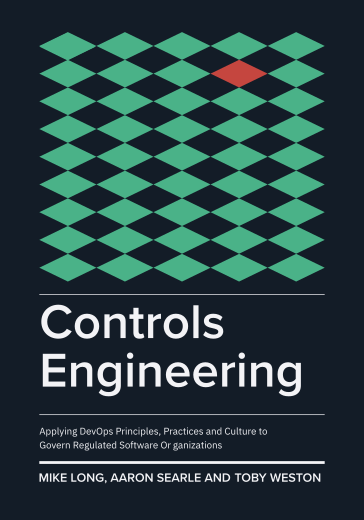
Explore Governance InfrastructureGovernance Engineering is being defined in the open: in the FINOS SDLC Common Controls Working Group, in the Controls Engineering book, and in The Control Group, our community for engineering leaders in regulated industries.
Come compare notes with the practitioners doing this work at the world's largest banks.
Join The Control GroupControls Engineering applies modern software engineering practices, requirements, testing, automation, observability, to the controls that govern software delivery. A control becomes a software product, not a paperwork exercise.
DevOps applied software engineering to operations. SRE applied it to reliability. Controls Engineering applies it to governance.
Read the guide the practitioners wrote, or talk to the team shaping the practice.
See the platform enterprise teams use to automate governance across build, release, and runtime.
Kosli in action