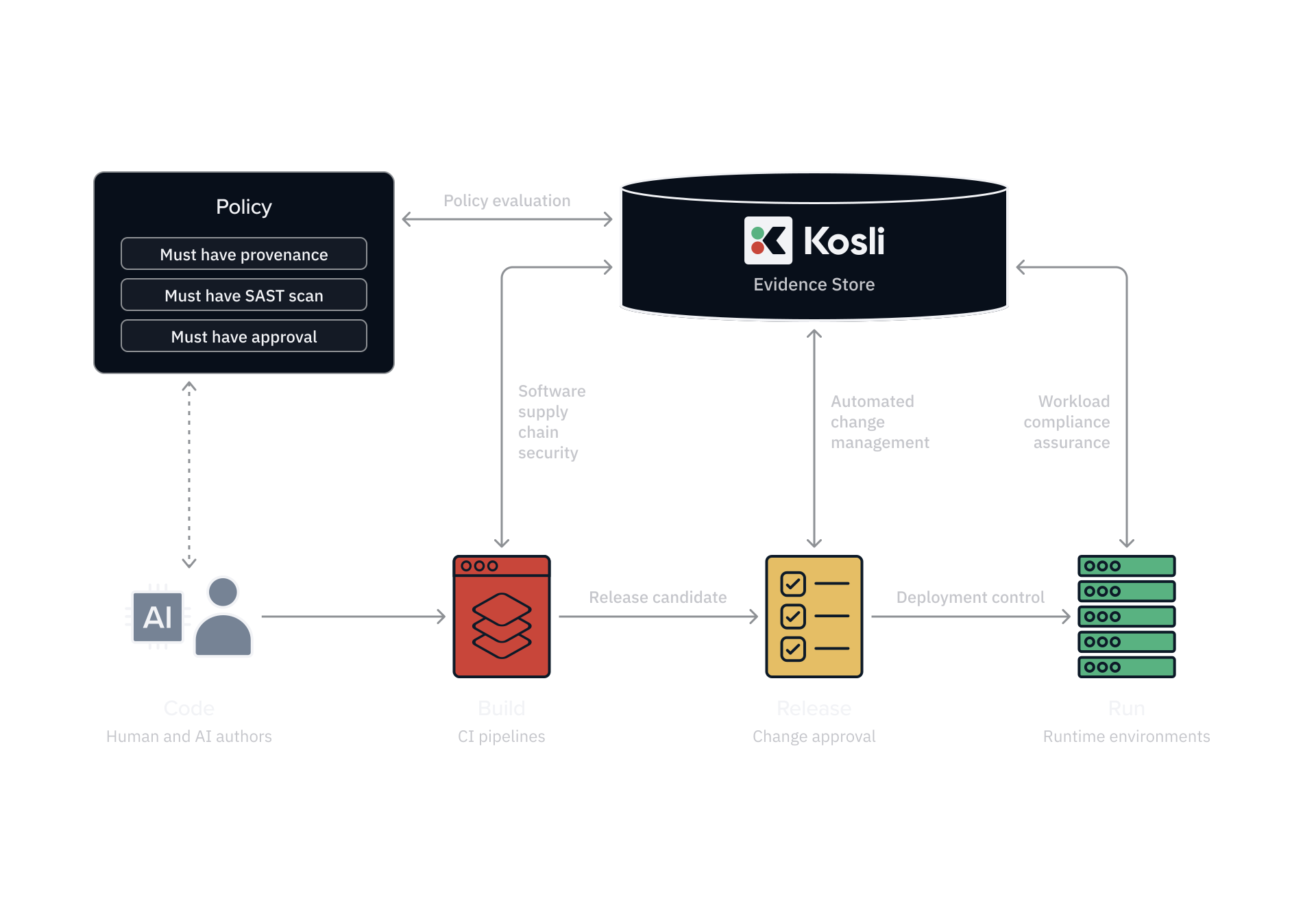
Build. Release. Run.
- Build
- Software Supply Chain Security
- Release
- Automated Change Management
- Run
- Runtime Security and Compliance
HOW IT WORKS
How Kosli records every event in your SDLC as a verifiable fact, turns those facts into automated controls, and proves compliance continuously — from commit to production.
Kosli is a technology stack for SDLC Governance Engineering built on proven technology principles. It has layered responsibilities, an immutable record, policy engine, computed projections, and it scales to large, complex enterprises.
GRC reporting tools
Governance Operations
Control Center
Evidence Store
Engineering toolchain
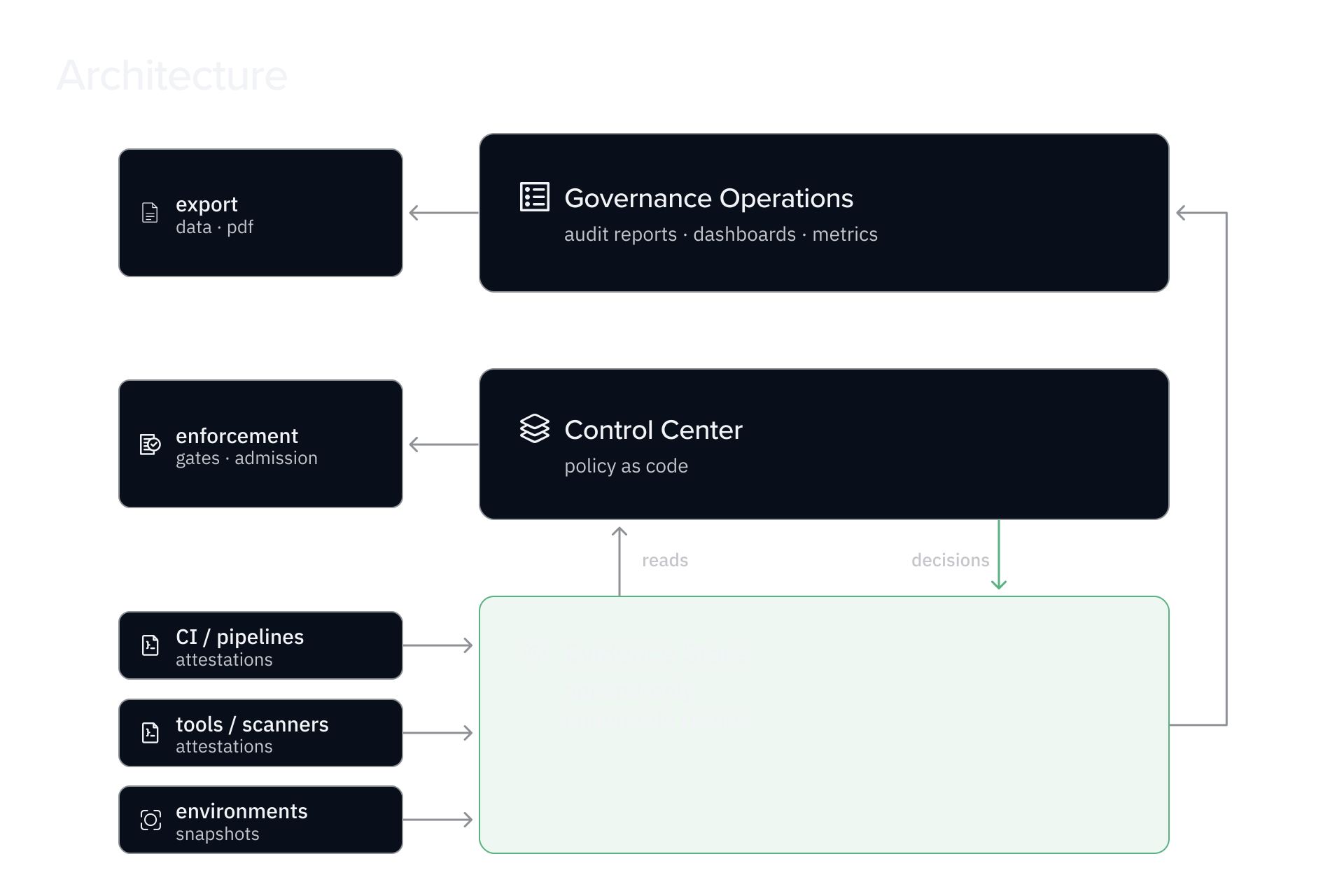
Governance Operations — audit reports, dashboards, and SDLC insights demonstrating continuous assurance to auditors and regulators.
Control Center — a policy engine for your controls, mapping control decisions to evidence, and operated automatically.
Evidence Store — a record of trusted facts from across the SDLC in an immutable, append-only record.
The foundation of SDLC governance is a trusted, central system of record. That's why the base of the stack is an append-only, immutable ledger of evidence.
Evidence is recorded as ATTESTATIONS: claims that an action happened (tests passed, a change was approved) and SNAPSHOTS: observations of the state of an environment.
Every artifact is identified by its cryptographic identity such as git commit or SHA256 checksum. Evidence is connected via identities or correlation ids, building a chain of custody from commit to production.
The system of record has no update and no delete. A correction is a new fact, and the old one remains. Kosli stores the record outside your infrastructure, so altering the history isn’t possible.
Define the fact types for your governance needs. Evidence that does not meet its schema is rejected at write time, and evaluated on ingest. Raw material (test output, SBOMs, scan reports) can be attached and fingerprinted in the Evidence Layer.
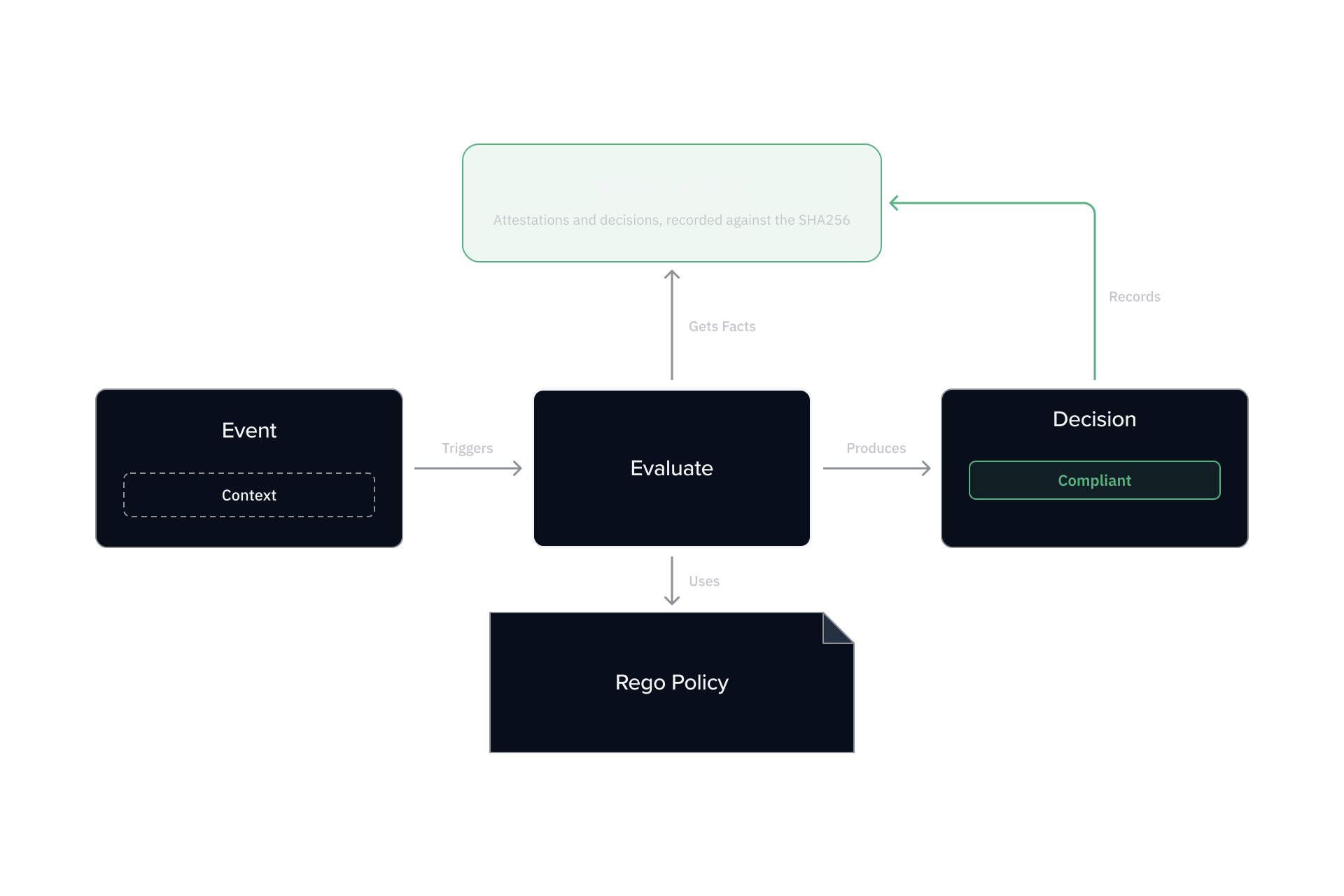
Control Center automates policy as code. Decisions are based on recorded evidence and context inputs. With automated controls an event triggers an evaluation of rules against trusted facts, producing a recorded decision.
Every control has a unique, immutable identity and a version history. Names and descriptions can change, but the history does not. Every decision records the control and policy version that made it.
Compliance requirements are versioned, testable policies, evaluated automatically. That means the the same input evidence produces the same decision, every time.
Compliant or non-compliant, with the reason, the policy version, and the evidence it read. The Control layer’s own actions are written back to the Evidence layer.
Decisions get enforced in CI pipelines, deployment tools, and admission controllers.
Emergency fixes and approved deviations are part of the system and it’s all recorded - who, what, when, and the reason.
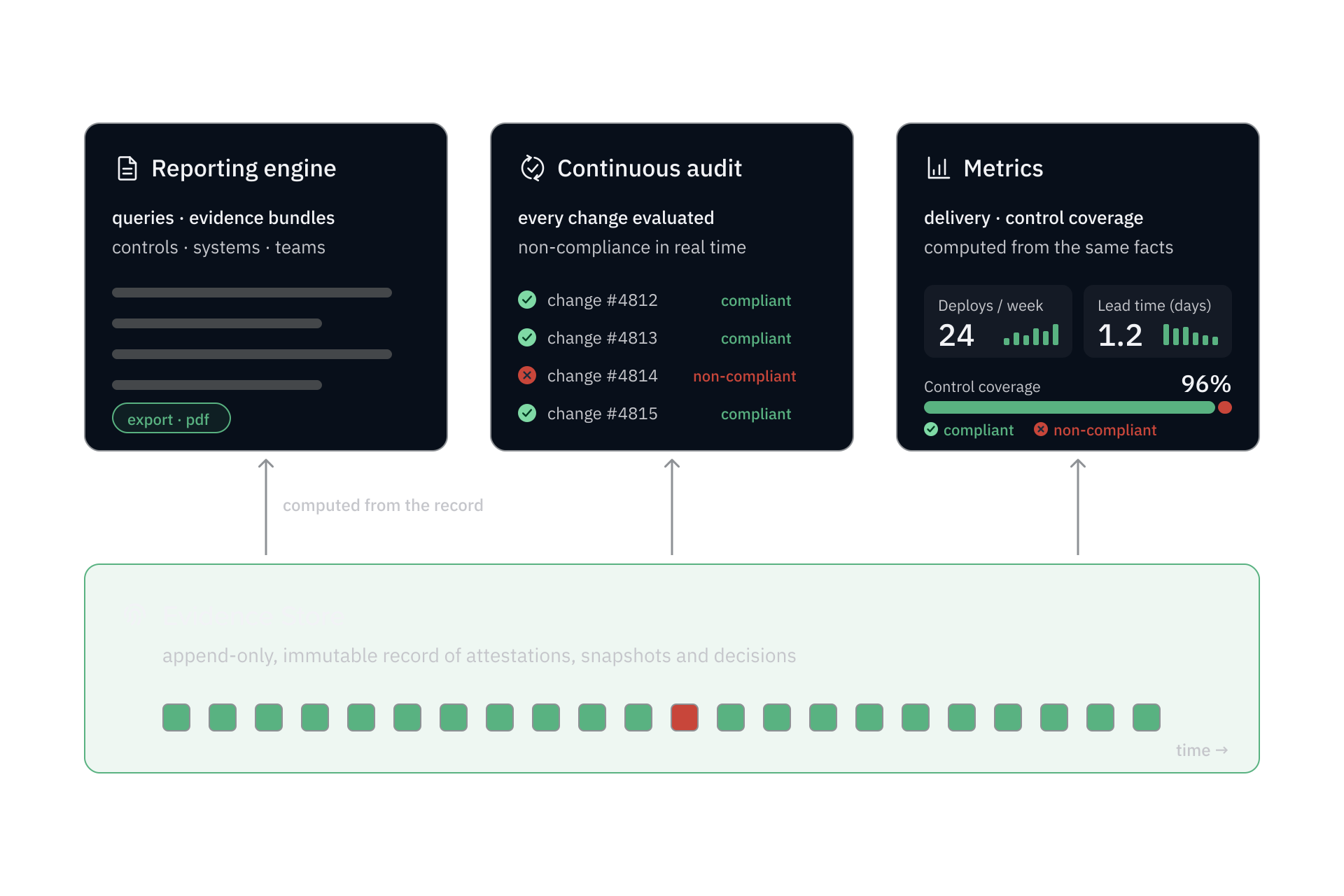
Assurance and insight are derived from a single source of truth. Reconciliation is continuous and anyone can verify it against the record at any time. Metrics are computed from the same set of facts, so they agree with the audit reports by construction.
Support for queries across controls, organizational entities and systems. Complete evidence bundles for any change - attestations, evidence files, spreadsheets and pdf reports.
Compliance evaluation with policies to find non-compliance in real time instead of at audit. Every change is evaluated against policy and evidence requirements.
Deployments are calculated from the evidence, not reported by people. The metrics agree with the audit reports because they come from the same facts.
Track which controls are enforced, compliance and non-compliance rates, and exception processes across the estate.
Scale, integration, isolation, and automation — what technical teams check before committing to governance infrastructure. Read the Deutsche Bank case study.
Kosli runs in production inside some of the world's largest banks, governing software delivery across estates that span mainframe, on-prem, cloud, and everything in between. The architecture is built for it — an append-only record that only ever grows, with reports, views, and metrics computed from it rather than maintained alongside it.
Kosli records facts from whatever you already have — CI systems, scanners, deployment tools, cloud accounts, legacy release processes. Evidence arrives through integrations, the CLI, or the API, so teams keep their existing pipelines and nothing has to be migrated before you get coverage.
Kosli Dedicated runs on isolated infrastructure with guaranteed resources, private endpoint connectivity inside your network perimeter, and dedicated encryption keys — for organizations whose regulatory or security requirements rule out shared tenancy.
About Kosli DedicatedEverything the product does is available over a documented REST API and the CLI, so Kosli fits the automation you already run. An MCP server exposes the same evidence and controls to AI agents and assistants, so agentic tooling can query the record and act on it directly.
MCP server docsControls Engineering applies modern software engineering practices, requirements, testing, automation, observability, to the controls that govern software delivery. A control becomes a software product, not a paperwork exercise.
DevOps applied software engineering to operations. SRE applied it to reliability. Controls Engineering applies it to governance.
See how Kosli automates SDLC Governance inside your environment.