
 3 min read
The financial service industry has spent years modernising their software delivery pipelines. Build and test cycles are fast, infrastructure is automated, and engineering capability is no longer the bottleneck. The slowdown now occurs at the end of the process: the last mile, where a change must prove it is safe before it can enter production.
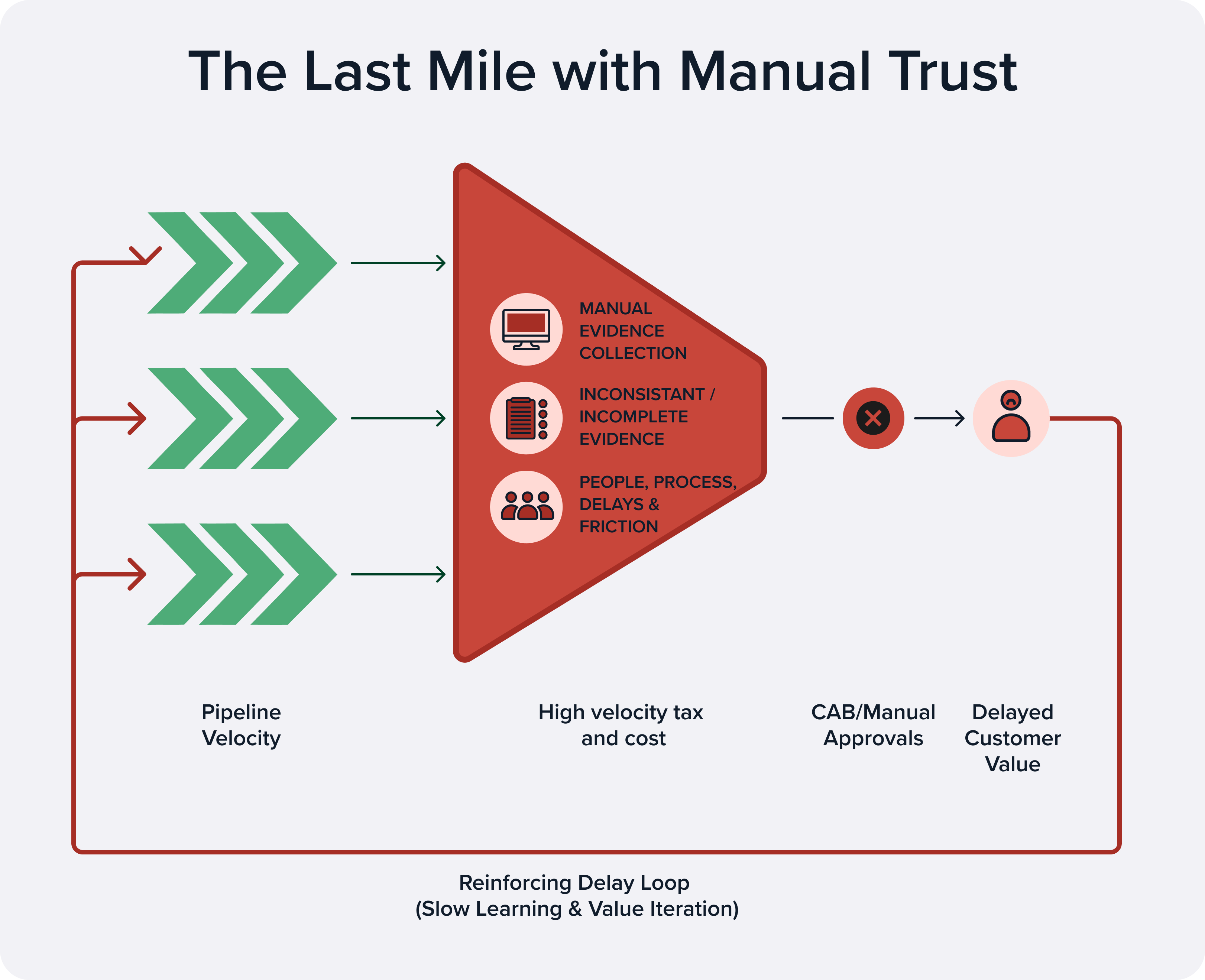
This final step is governed by a trust layer with people in it. Because the SDLC and CMDB do not share lineage, evidence, or control results, trust is created manually through CAB’s, approvals, documentation, screenshots, and retrospective audit trails. Even the simplest standard changes, designed to be pre-approved and low-risk, move slowly because they must pass through this same manual layer.
How Velocity Tax Becomes Velocity Debt
Every change absorbs the cost of this process. That cost is the Velocity Tax, the recurring delay, friction, and human effort required to release software. Over time, the tax accumulates into Velocity Debt, a deeper structural drag that inflates the cost of delivery, reduces responsiveness, and strains engineering and governance teams alike.
This accumulated debt now collides with new pressures. CIOs are asked to deliver faster to remain competitive, deliver safer under regulatory expectations, and deliver cheaper amid economic and headcount constraints. A human trust layer cannot satisfy these demands. It is too slow to scale, too manual to provide continuous evidence, and too costly to maintain.
The underlying tension is structural. Banks operate with two necessary value systems: the Commercial logic of engineering, which favors speed and iteration, and the Guardian logic of risk and audit, which requires certainty and control. When trust is manual, Guardian values dominate by necessity; the evidence they receive is incomplete and inconsistent, and caution becomes the only rational response.
Automating Trust to Restore Velocity
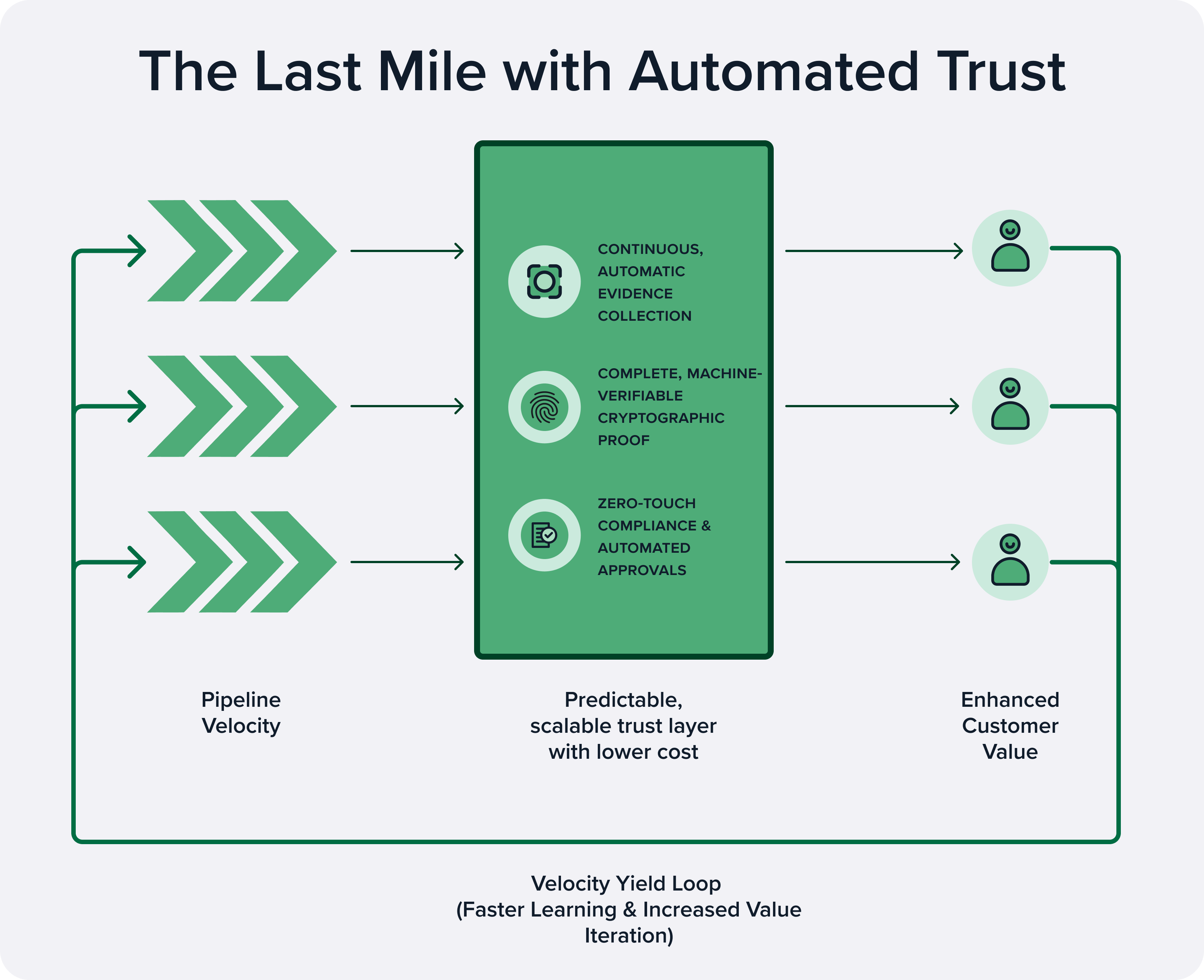
The only way to reconcile these forces is to strengthen the trust model itself. Systems that generate cryptographically proven attestations provide an immutable, verifiable record of every artifact, change, control, and environment state. Instead of requiring people to produce or interpret evidence, the system produces the undisputed truth automatically.
When trust becomes cryptographic rather than human, the dynamics of the last mile shift immediately. Standard changes complete in minutes instead of weeks. CMDB accuracy becomes continuous. Audits move from reconstruction to verification. Engineering and governance teams reclaim time previously spent on administrative work. The Velocity Tax diminishes, and the accumulated Velocity Debt begins to unwind.
This is Velocity Yield, the point at which faster delivery aligns with stronger control and lower cost. It is not achieved by pushing people harder, but by replacing manual trust with system-generated truth. For banks preparing for 2026 and beyond, automating the trust layer is not a tooling decision; it is the structural change required to restore velocity, reduce cost, and meet the expectations of regulators and customers alike.